- The Journey of Rama
- Posts
- Episode Eight - Princes Will Be Boys
Episode Eight - Princes Will Be Boys

C.L. Steiner
June 11, 2025
Welcome to the eighth episode of The Journey of Rama. If this is your first encounter with The Journey, please read Episode One first.
The Table of Contents is here:
If you haven’t subscribed to The Journey of Rama, please consider a subscription. You’ll never miss an episode, and they’ll come directly to your inbox!
Every episode is available for free, but if you wish to support the work of creating this publication, click the “Contribute Here” button. 50% of all contributions will be donated to Dhyanyoga Centers.
On with Episode eight!
The four princes were no longer babies. Before the royal household knew it, Rama, Bharat, Lakshman, and Shatrughna were four energetic boys who loved to run everywhere and play all manner of games.
From time to time, King Dasharatha would take a break from his schedule to play with his sons or sit by the window and watch Rama and his brothers. The King’s minister, Sumant, taught the young boys how to use the bow and arrow safely, and they were all becoming quite proficient. Sumant would devise games that would improve their skills while having fun.

One evening, Sumant asked the boys, “What do you have planned for tomorrow, my Lords?”
“Let’s have wrestling matches!” said Lakshman. Sumant laughed, knowing how much Lakshman loved a battle.
Rama, however, knew that whenever Sumant asked them this question, it meant that he had a new game for them to play. “What would you have us do, noble Sumant?” asked young Rama.
“Well,” answered Sumant, “since the mangoes on the trees are ripe, perhaps you would like to try to shoot them down? How about a contest to see who gathers the most mangoes?”
Lakshman said, “I’ll shoot down the most!” “No,” said Bharat, “My arrows are the fastest!” “I can shoot more than any of you,” Shatrugna said. Rama just smiled.
The following morning, all the boys woke up early, wanting to begin the contest immediately.
“Wait!” said Queen Kaikeyi, “you must wash and then pray!” “Then you must bow before your father,” said Queen Sumitra. “And have something to eat,” added Queen Kaushalya, “then you may take up your bows and arrows.”
“So much to do,” said Rama. “Why didn’t we wake up earlier?” asked Bharat.
Soon the boys were in the mango grove, aiming their arrows at the stems holding the mangoes to the trees. Each boy shot in turn, sometimes missing, sometimes dropping sweet ripe mangoes to the ground. Servants gathered the mangoes onto platters, each platter inscribed with a prince’s name to keep the score.
From his fierce determination, everyone could see that Bharat very much wanted to win this contest.
After a long period of shooting, each boy had an equal number of mangoes, and Sumant called out, “Now, all four of you fire your arrows at once, and the one who drops that big mango is the winner!”
All four arrows flew, and Rama’s arrow found the target. “Rama wins!” called Sumant. Rama looked at his brothers and said, “No, Sumant, it wasn’t my arrow. It was Bharat’s.” Lakshman said, “No, brother, it was yours! What are you saying?”
Rama’s willingness to make Bharat happy was boundless. Rama loved his brothers profoundly and knew how much Bharat wanted to win the contest. He gently put his hand on Lakshman’s arm and said, “Bharat’s arrow found its target. He wins.”
Sumant called young Rama aside. “Your royal highness,” he said, “I know the love you have for your brothers, but it is not good that you should speak falsely.”
“Noble Sumant, I meant no falsehood. I spoke of the arrow of Bharat’s desire, finding its target in my heart. ‘Shooting mangoes’ is a game, and when one brother wins, do we not all win?”
Sumant was stunned at young Rama’s understanding and judgment.
One morning, King Dasharatha summoned his four sons to his chamber from the field where they had been playing. As the princes entered the room, they saw Guru Vashistha standing near the King. They bowed first to the Guru, then to their father, and then stood waiting for their father’s word.
“My sons,” said the King, “it is time to begin your education. Gurudev will take you to his Ashram, where you will learn all the arts and sciences.”
Rama and Bharat nodded. They had been waiting for this significant step in their life. The other two boys stepped forward to pose questions.
“Father,” asked Shatrugna, “why must we go to the Ashram in the forest? Why can’t we be educated here at home in the palace?”
“And,” said Lakshman, “we are princes! We all love and respect you, Guruji, but why does a prince need a Guru?“
King Dasharatha and Vashistha looked at each other and smiled. Guru Vashistha turned to the boys and said, “Your two questions, and many others, will be answered completely, but not today. You will learn the answers during your studies at the Ashram.”
“Yes, Guruji,” all four said in unison. They nodded to each other and shouted, “Jai Gurudev! Victory to the Guru!”
On the day the four princes arrived at the forest ashram, they were given ochre robes and had their heads shaved. Although Guru Vashistha’s hair was long and coiled atop his head, all the students had their heads shaved except for the shikha, a tuft of hair at the crown.
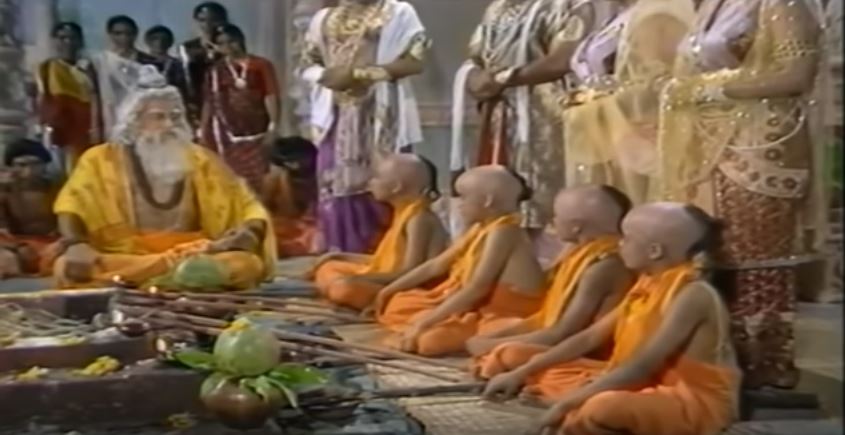
The first night, they were taken to the young students’ hut and given mats on which to sleep. The youngest students were housed next to the cabin Guru Vashistha shared with his wife, Arundhati.
That night, as they were getting ready to sleep, Lakshman asked Rama, “Why did they shave our heads?” Shatrugna agreed, “I liked my hair!” he said, “I liked all our hair!”
“Look at us and look at the other students, my brothers,” said Rama. “With our heads shaved and in the same robes, we all look alike! Who is from the city, and who is from a village? Who is the son of a farmer, and who the son of a king?”
“Hmm...” thought Shatrugna aloud, “is that why we had to come to the Ashram? “To learn to work and play with others, no matter where they come from or who their fathers may be?”
Vashistha, walking past the doorway, overheard the boys’ conversation and smiled.
Indeed, the four princes became friends with boys from forest tribes and noble houses; all were equal before the Guru and to each other.
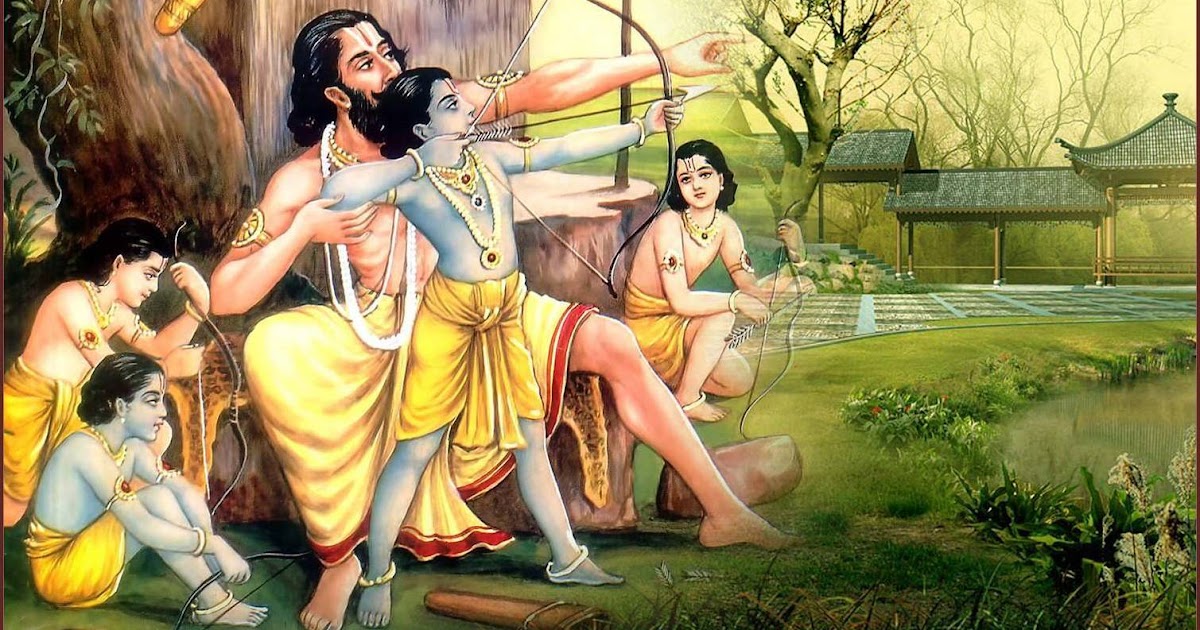
The four princes excelled in their studies in the weeks and months that followed. They learned spiritual practices, languages, weaponry, etiquette, science, Hatha Yoga, and more. Everything they studied, they learned quickly and thoroughly. Rama mastered each subject first, and his brothers learned soon after.
Rama learned all the Vedic scriptures as quickly as Guru Vashistha could teach them, but Vashistha was not surprised – he was a Rishi – a great sage who came to realize in his meditations that the prince Rama was Shri Rama, who had come to save the world from evil. One night, he said to his wife, Arundhati, “Of course, Rama learns the scriptures. He is the scriptures!”
I’m not putting any of The Journey of Rama behind a paywall - I wouldn’t feel right. Feel free to take a subscription.
I do hope, however, that you will contribute. Writing is how I make my living, and I’d like to spend a lot more time working on this if I can afford to. Additionally, 50% of the income I derive from this work will be donated to Dhyanyoga Centers to support the spiritual and humanitarian endeavors of my Guru, Shri Anandi Ma. If it weren’t for Her, I’d never have been introduced to the Ramayana. The Journey of Rama is a reader-supported publication.
Reply