- The Journey of Rama
- Posts
- Episode Five - Two Kingdoms Plan
Episode Five - Two Kingdoms Plan

C.L. Steiner
May 19, 2025
Welcome to the fifth episode of The Journey of Rama. If this is your first encounter with The Journey, please read Episode One first.
The Table of Contents is here:
If you haven’t subscribed to The Journey of Rama, please consider a subscription. You’ll never miss an episode, and they’ll come directly to your inbox!
Every episode is available for free, but if you wish to support the work of creating this publication, click the “Contribute Here” button. 50% of all contributions will be donated to Dhyanyoga Centers.
On with Episode Five!
The demon king Ravana arrived at table, and the Asuras in his royal court, feasting raucously in the great hall, fell silent upon his entry. Ravana was a most imposing figure in a land of imposing figures. The Asuras were big, and the members of the Rakshasa clan to which Ravana belonged were bigger. Except for his brother, the giant Kumbhakarna, Ravana was the largest Rakshasa.
Ravana’s body was solid muscle, and his loose-fitting clothes were made of the finest silks. He wore a golden band around each of his biceps, and an enormous crown sat upon his head.
Ravana strode to the head of the table and stood still, making sure he had everyone’s complete attention. He looked first to his right at old Malyavan, his maternal grandfather and chief advisor, then to his left at his younger brother Vibishana. Ignoring his plate piled high with meat, he asked, “How go the campaigns?”
Malyavan spoke first. “Domestic or external, your Majesty?”
“Did not my use of the plural give you a clue, respected grandfather?” Ravana’s tone showed not a hint of respect.
Vibishana softly changed the subject to save their grandfather embarrassment, “I will begin with the domestic campaign. The people of Lanka are content and prosperous, though they do not worship the Gods. Since much of the populace is not demonic, I propose we reconstruct at least a few of the temples that have fallen into disrepair. Perhaps we can also recruit some priests from the mainland and....”
Ravana cut his brother off. “The people are content and prosperous. Thank you, brother.”
“I was putting forth a proposal, my Lord, based on your own devotion to Lord Shiva.”
“And I do not wish to hear your proposal. The people of my kingdom are not demons, but demons rule them. If they need an object of worship, that object should be their King, who is not only a Rakshasa but the ruler of all! Need I remind you, Vibishana, that the Gods themselves now bow before me? You speak of temples – I believe every home on the island of Lanka should be a temple. A temple to Ravana! Anything further?”
“No, Your Majesty.” Vibishana sipped water.
Ravana sat and lifted a large piece of animal flesh from his plate. “Now, grandfather, how goes the external campaign?” He took a bite and chewed while staring at the older man.
Malyavan took a deep breath, then said, “Your troops control all lands south of Kishkindha. Those kingdoms retain their kings, who are paying tribute to us for protection from their enemies, of whom there are currently none.”
A Rakshasa seated further down the table and dressed in a general’s garb asked, “Your Majesty, do you wish for us to invade Kishkindha?”
Ravana thought for a moment, then answered, “I think not, Prahasta. It is a Vanara kingdom, and since the Vanaras are monkeys, neither human nor demon, they are unimportant to me at this time. Besides, I have a treaty with their King, Bali, and his friendship may prove valuable. But thank you for asking, General.” He took another bite of meat and washed it down with ale.
He turned to Vibishana and spoke quietly, almost kindly. “Vibishana, you are doing an excellent job of keeping the humans in our kingdom employed, well-fed, and entertained. Please continue. I would, however, like to see an increase in violent forms of entertainment.”
Vibishana did not smile. “Thank you for your praise, dear brother. I fail to see the need, however, for violence. Is it wise to awaken a thirst for battle among the people?”
“Distraction, Vibishana! Displaying brutality and bloodshed does not encourage it among these people, not against us!” Ravana curled the fingers of his right hand into a fist and held it before him. His voice was loud but controlled. “Hearts and minds, Vibishana, hearts, and minds! We win them by keeping the humans happy but fearful. And if we fail to win a heart, we tear it out and eat it!”
Ravana waved his arm to dismiss the demons. He wanted to finish his meal alone.
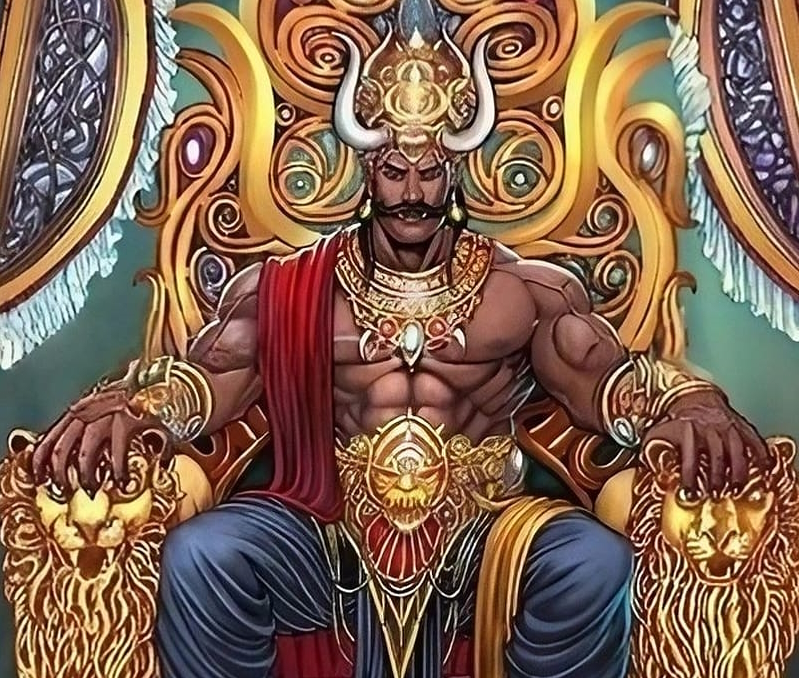
Ravana courtesy peakpx.com
In Ayodhya, servants pampered the three Queens more and more as their pregnancies progressed. There was no craving that went unfulfilled. The King had ordered that each queen be carried from place to place on a palanquin, but Kausalya would not hear of it.
“My lord,” she said at breakfast one morning, “I am going to give birth; I have not lost the use of my legs.” The other queens, who might have enjoyed that form of transportation, said nothing.
“I want to make sure that the three of you are comfortable and do not come to harm,” said Dasharatha.
“And I,” Kausalya replied, “want to ensure that we maintain our strength and are not dropped.” This ended the conversation, and the palanquin-bearers were dismissed.
Kausalya and Sumitra spent much of their time directing the preparation of the nursery. They were of one mind as far as the decorations were concerned, but disagreed on whether to have cribs or cradles. Kausalya favored cradles, and Sumitra preferred cribs, but they never argued. Kaikeyi had not yet offered an opinion, and she would break the tie, so there was no need for contention.
Kaikeyi, in fact, had hardly left her quarters. Her maidservant, the aged, hunchbacked Manthara, saw to her every whim.
The time seemed to pass very slowly for the queens, but as the births approached, they all felt as though the fire ceremony had been no more than a week before. Manthara rapped the tip of her cane against the marble floor at the entrance to Queen Kaikeyi’s quarters. “My queen,” she called loudly, “the other queens are demanding your presence in the nursery! I told them you were in bed, but they are insisting!”
Kaikeyi rose from the couch on which she reclined, “Manthara, why are you shouting? I’m right here.”
“Oh, forgive me, Your Majesty. Your sister queens are calling for you. I don’t understand why they won’t give you a moment’s peace!”
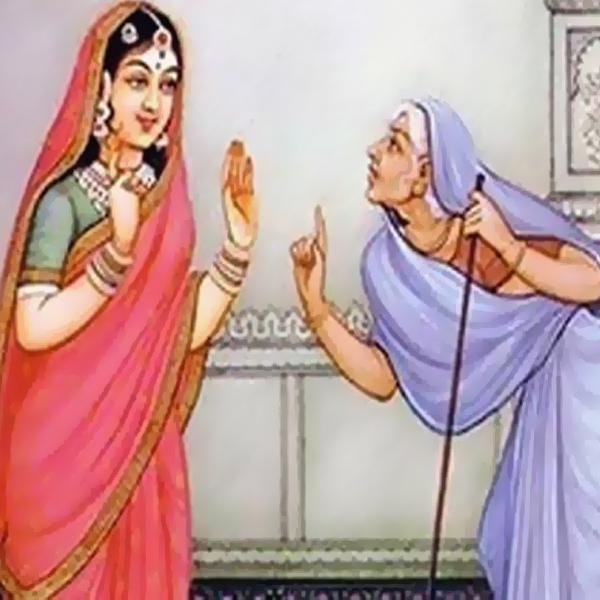
“You’re being very silly, Manthara. I’ve hardly spent any time with my sisters at all! You keep me here like a prisoner, stuffing me with sweets and massaging my feet all day! It’s time I went and helped with preparations.”
Manthara huffed. “Well, if you feel you must, my Queen. Let me get servants to carry you.”
“Please stop, Manthara! I’m perfectly capable of walking, as Kausalya has pointed out.”
Manthara made a displeased and unpleasant sound in her throat. “As you wish, Your Majesty.”
Kaikeyi had a simple solution to the nursery problem. “Both!” she exclaimed. “We should have cribs for when the babies are sleeping and cradles to lull and soothe them.”
Sumitra and Kausalya clapped their hands in agreement. “How else may I be of service?” Kaikeyi asked.
Dasharatha sat on his throne with his chin in his hand. All three queens had gone into labor almost simultaneously. Kausalya was the first to cry out, followed moments later by Kaikeyi, then Sumitra after a quarter-hour.
The royal physician, assisted by three midwives, had ordered that the queens be taken into one large room so he could watch each one’s progress. Any other servants had to wait in the next chamber for instructions. Manthara was beside herself, repeatedly complaining that she should be at her queen’s side, but no one paid attention to her.
Dasharatha called Sumant, his minister and friend, to his side. “I don’t know what to do with myself, Sumant. I pray all goes well, but I am as nervous as a mouse facing a cobra.”
Sumant smiled. “May I suggest a game of backgammon, my Lord?”
Two maids appeared at the throne room entrance as they set up the board. Their smiles lit the room. “Your Majesty!” one cried out, “Queen Kausalya has given birth to a son!”
Dasharatha sat, mouth agape. “Thank you,” said Sumant, “you may go.” The King was in a trance.
“Sire,” Sumant laid a hand on the King’s hand, “that’s one. You should thank the messengers as they come.”
“What? Oh, of course, Sumant. Did you hear? I have a son!”
“Yes, Your Majesty. Congratulations!”
And two more maids appeared at the door. “Queen Kaikeyi has given birth!”
Dasharatha and Sumant spoke as one, “To?”
“Oh!” giggled the maids, “a son!”
“Thank you,” said the King, “you may go!”
“I can’t wait to see them,” Dasharatha said.
“You’ll see them for the rest of your life if the Gods will it,” said Sumant.
“I don’t think I can play backgammon now,” said the King, and they both laughed.
Two more maids appeared. “Your Majesty! Queen Sumitra has given birth!”
“A son?”
“No, Your Majesty. Two sons!”
“Jaya Bhagavan! Praise God! I have four sons! Sumant – I had no son, now I have four. The Gods are good!”
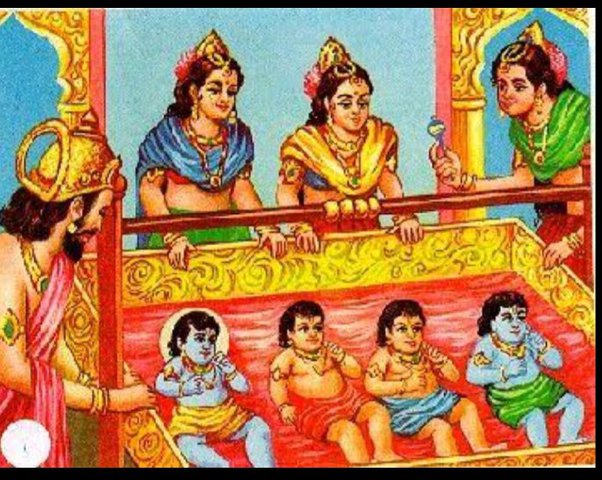
The King did not know how good. Dasharatha had no idea that Lord Vishnu himself had taken birth in his palace.
If you’re enjoying The Journey of Rama, please share it via email or social media!
I’m not putting any of The Journey of Rama behind a paywall - I wouldn’t feel right. Feel free to take a subscription.
I do hope, however, that you will contribute. Writing is how I make my living, and I’d like to spend a lot more time working on this if I can afford to. Also, 50% of whatever income I derive from this work will be donated to Dhyanyoga Centers to support the spiritual and humanitarian work of my Guru, Shri Anandi Ma. If it weren’t for Her, I’d never have been introduced to the Ramayana. The Journey of Rama is a reader-supported publication.
Reply