- The Journey of Rama
- Posts
- Episode Nineteen - The Wedding
Episode Nineteen - The Wedding

C.L. Steiner
September 09, 2025
Welcome to the nineteenth episode of The Journey of Rama. If this is your first encounter with The Journey, please read Episode One first.
The Table of Contents is here:
If you haven’t subscribed to The Journey of Rama, please consider a subscription. You’ll never miss an episode, and they’ll come directly to your inbox!
There are three ways to support The Journey of Rama.
Every episode is available for free, but if you wish to support the work of creating this publication, click the “Contribute Here” button. 50% of all contributions will be donated to Dhyanyoga Centers.
Share The Journey of Rama on your social media (use the Share button).
Click the Like button.
On with Episode Nineteen!
राम राम राम राम राम राम राम राम राम रामराम राम राम राम राम राम राम राम राम रामम
The massive parade from Ayodhya approached Mithila. Dasharatha and his court rode atop elephants painted with brightly colored mandalas while the queens were carried in palanquins bedecked with bright silk saris. The Brahmins of Ayodhya, in their ochre robes and wooden sandals, walked in long strides as astrologers, bards, and musicians were carried on the backs of horses and mules. Porters marched with the loads they bore across their shoulders or balanced on their heads.
Janak’s court was prepared to receive whatever number of the bridegroom’s family and countrymen had made the journey. Janak himself stood on the parapet and watched as Sumant, Dasharatha’s charioteer, minister, and friend, readied a pair of chariots for his king. Dasharatha bade his guru, Vashistha, to mount the first chariot, and then the king climbed aboard the other.
As the chariots entered Mithila’s gate to the sound of drums and trumpets, flower petals rained down from the heavens, displaying the Gods’ pleasure in seeing this wedding procession. Music, both earthly and celestial, rang out as Mithila’s townsfolk danced in the streets and flung colored powders in the air and onto each other.
All sorts of auspicious omens appeared as the chariots of the king of Ayodhya and his Guru rode through the streets of Mithila. They passed a white cow suckling its calf as two learned Brahmins approached the street, each with a book in his hand. A family of deer approached the parade despite all the noise. All these signs were taken as blessings.
As the procession approached the palace, hundreds of Janak’s servants came out to direct members of Dasharatha’s party to their appropriate lodgings. Other servants brought trays of sweets and beverages to welcome the bridegroom's party.
Unbeknownst to anyone, Sita (who was, of course, Goddess Lakshmi’s avatar on Earth) manifested a bit of her glory, ensuring that each person’s lodgings were comfortable and that each was served the foods that pleased them most. Everyone praised King Janak; only Rama discerned Sita’s influence and smiled inwardly.
The two brothers, Rama and Lakshman, ached to see their father and mothers, but waited patiently for their Guru’s permission. Vishvamitra, pleased to see their discipline and humility, smiled and waved his hand. “Let’s go. Your parents are waiting!”
Dasharatha was delighted to see his sons approaching, but as ever, he obeyed the rules of propriety, prostrating himself before Vishvamitra as Rama and Lakshman bowed and touched the feet of Guru Vashishtha. Then the king embraced them.
The other two brothers, Bharat and Shatrugna, raced in from another room and hugged Rama and Lakshman, forgetting propriety in their joy.
“Where are our mothers?” asked Lakshman. Bharat pointed to another chamber, and Rama and Lakshman bowed again and went to greet the queens, who stood teary-eyed as their sons bowed and touched their feet.
The wedding was set for the following day, and there was much music and feasting throughout Mithila that night. The citizens all talked about how charming and handsome the four brothers were and how delighted they were that their princess was marrying Lord Rama. The women of Mithila wondered if there was a way for all four brothers to be wed in Mithila.
The wedding day was the fifth day of the bright fortnight in the ninth month, Margashirsha. The auspicious date had been established by the gods and determined by Janak’s astrologers. The hour before sunset was the proper time. Although Margashirsha marks the beginning of the cold season, all was warm and bright in the city.
Along with their preceptors, each of the two kings had performed the family rites prior to marriage. The Brahmins came to Dasharatha and said, “The hour has come, and now we can start.” Dasharatha and his queens followed the holy men to the wedding area.
As the sun dipped low in the sky, the gods appeared, disguised as stars in the cloudless sky; none was willing to miss this ceremony. Lord Shiva called upon them all to pay attention. “Be not lost in wonder,” he said, “ponder in your heart that this is the wedding of Lord Rama and his beloved Sita. At the very mention of Rama’s name, all evil is uprooted. With the divine energy of Mother Sita, he delivers the goals of human existence to all who desire them. These are Sita and Rama!”
Musicians marched through the streets playing drums, pipes, and tambourines as the women of the city sang bhajans extolling the virtues of Rama and Sita. The Brahmins chanted Vedic mantras as the wedding hour drew closer.
Rama arrived on a pure white steed, followed by his three brothers. The women of the city lit butter lamps on brass and silver trays to perform the aarati, the waving of lights around the bridegroom as he dismounted. Their bangles made tinkling sounds as they sang and swayed their lamps. Gods and Goddesses, disguised as ordinary citizens, were delighted to attend these nuptials.
The crowd of women in front of Rama parted to allow Sita’s mother, Queen Sunayana, to come forward to wave her lights before the bridegroom. After the aarati, she offered Rama water with which to wash his hands.
The kings, Janak and Dasharatha, stood smiling before the crowd and raised their right hands for silence. Janak announced,
“We have heard the voices of our people, and the King of Avadh and I have determined that his other sons will also marry! Lakshman will wed Sita’s sister, my daughter Urmila, Bharat will marry their cousin Mandavi, and Shatrugna is paired with Mandavi’s sister, Shrutakirti! These nuptials are a blessing for both our kingdoms!”
The crowd roared its approval as the two kings embraced each other. The four brothers entered the pavilion to await their brides. Dasharatha and Janak performed the ritual offerings required of the fathers, then summoned the gurus Vashistha and Shatananda.
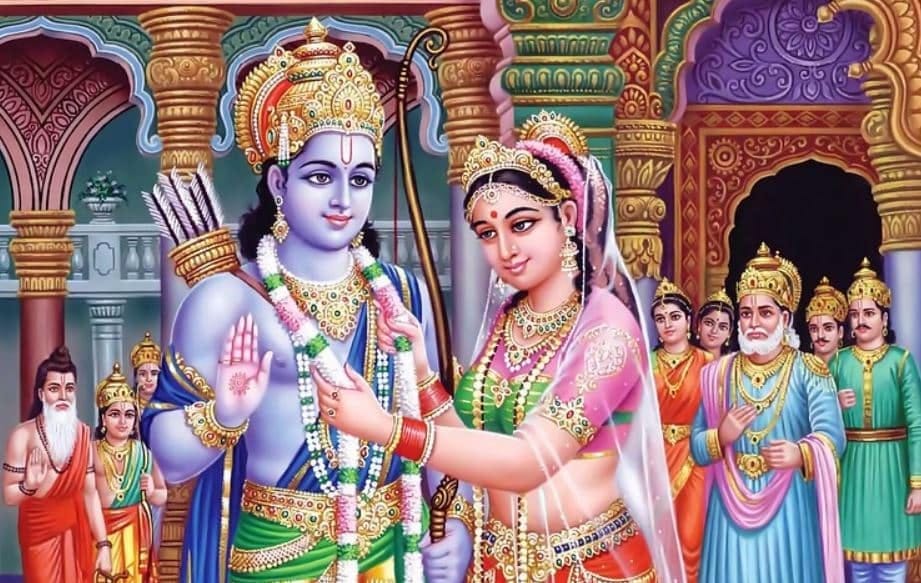
The women of Janak’s household, led by the Queen, conducted Sita, Urmila, and their cousins into the pavilion as Brahmins chanted the mantras appropriate to the event, and at the auspicious hour, Vashistha and Shatananda performed the wedding rites. Rama and Sita sat beside each other on twin thrones, and the other three couples surrounded them. At the same time, Brahmins sat at the sacred fire and made offerings to the Gods.
Lakshman and his bride, Urmila, gazed into each other’s eyes. Bharat took the hand of Mandavi while Shatrugna and Shrutakirti smiled joyfully at each other. Each of the four bridegrooms offered food to his bride, after which each bride did the same to her husband.
All in attendance shouted “Jai Siya Ram! Victory to Sita and Rama!” again and again.
It was a wedding like any other. It was a wedding like no one had ever seen before. Only the Gods knew that this was the reunion of Vishnu and Lakshmi in earthly form, and they rained flowers down upon the celebrants.
राम राम राम राम राम राम राम राम राम रामराम राम राम राम राम राम राम राम राम रामम
I’m not putting any of The Journey of Rama behind a paywall - I wouldn’t feel right. Feel free to take a subscription.
I do hope, however, that you will contribute. Writing is how I make my living, and I’d like to spend a lot more time working on this if I can afford to. Additionally, 50% of the income I derive from this work will be donated to Dhyanyoga Centers to support the spiritual and humanitarian endeavors of my Guru, Shri Anandi Ma. If it weren’t for Her, I’d never have been introduced to the Ramayana. The Journey of Rama is a reader-supported publication.
Reply