- The Journey of Rama
- Posts
- Episode Seventeen - Parashurama, The Warrior/Sage
Episode Seventeen - Parashurama, The Warrior/Sage
C.L. Steiner
August 26, 2025
Welcome to the seventeenth episode of The Journey of Rama. If this is your first encounter with The Journey, please read Episode One first.
The Table of Contents is here:
If you haven’t subscribed to The Journey of Rama, please consider a subscription. You’ll never miss an episode, and they’ll come directly to your inbox!
Every episode is available for free, but if you wish to support the work of creating this publication, click the “Contribute Here” button. 50% of all contributions will be donated to Dhyanyoga Centers.
On with Episode Seventeen!
राम राम राम राम राम राम राम राम राम रामराम राम राम राम राम राम राम राम राम रामम
Not everyone in the arena was happy about the Swayamvara’s outcome. Some of the princes, who were overcome with desire for Sita but had been unable to lift Shiva’s bow, started grumbling. One stood and began to don his armor. “Why don’t we capture those two boys and carry Sita away?” Another rose from his seat and chimed in, saying, “The bow makes no difference. We can defeat Janak’s guards easily enough, along with those two brothers!”
One of the kings sitting nearby stood and faced the young fools. “Apparently, shame isn’t enough for you. Your valor was broken along with the bow! What is wrong with you? You’re two covetous beggars conspiring to rob a palace. If not for your jealousy and arrogance, you would rejoice at seeing Rama and Sita together. Besides, everyone knows Lakshman’s anger is a wildfire and would consume the two of you as though you were moths. Dare not get too close.”
Lakshman overheard the argument and turned toward the princes but, out of respect for Rama, said nothing. His eyes said it all. The two princes sat, looked at the floor, and waited for an opportunity to make their exit.
At that moment, a whirlwind in the form of a man entered the arena. Everyone saw, and everyone was hushed by his presence. Below the matted rings of hair that topped his head were three horizontal stripes of ash: the Tripundra, the mark sacred to Shiva. Although his garb was in the fashion of a forest sage, it was made of tiger skin. He wore an arrow-filled quiver on his back, a bow on his shoulder, and carried an axe in his right hand. This was Parashurama, known to all for single-handedly decimating the warrior caste of several kingdoms, and the look on his face was one of barely controlled rage.
The kings and princes who were still in the arena came to the floor and prostrated themselves to him. Janak approached him and bowed, followed by Sita. Parashurama raised his hand in blessing over the princess. Janak and his queen each took a deep, relieved breath.
Vishvamitra brought Rama and Lakshman up to the great warrior/sage and introduced them as the sons of Dasharatha. Parashurama again raised his hand in blessing.
“What,” he asked, his voice soft but dripping with malice, “has attracted such a crowd here today?”
Janak began to relate the story behind the Swayamvara as Parashurama looked around. His eyes settled on the broken bow. Interrupting the king, he growled, “And tell me, Your Idiotic Majesty, who has broken the bow of Shiva?”
No one spoke.
“Show him to me at once, or I will destroy your palace, everyone in it, and the entire city of Mithila!”
Janak could not bring himself to respond. Seeing the fear in every face, Rama stepped forward with neither fear nor arrogance. “My lord Parashurama, it could only be one of your servants who has broken the bow.”
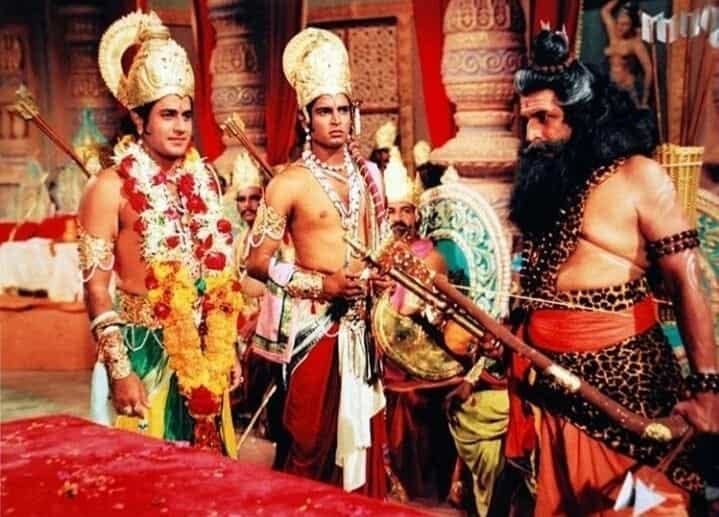
Rama, Lakshman, Parashurama - video capture courtesy of Sagar Arts
“A servant,” snarled Parashurama, “is one who does service. Whoever has broken the bow of Shiva is my enemy, not my servant! Let him stand apart and show his face, or I shall slay every one of these kings and princes!”
Lakshman took a step toward Parashurama. “I have broken many a small bow in my childhood, but you never appeared, my lord. Why are you so fond of this one bow?”
Through gritted teeth, Parashurama responded. “Apparently, youngster, you have lost your senses speaking to me like this. This is the great bow of Shiva, not some toy!”
Lakshman grinned. “Holy sir, all bows are alike to me. My brother Rama mistook it for a new one, and at his touch, it snapped in two. It certainly wasn’t his fault. What are you so angry about?”
“Child, the only reason I do not slay you right now is because you are a child, and apparently a stupid one. I have destroyed warriors and kings with this axe, and in an instant, I can bring grief to your parents.”
Lakshman’s grin increased, and he spoke very softly. “You are obviously a great sage. But are you an extraordinary warrior as well? You show off your axe, but I am no budding flower, sir. When I saw you armed with a bow and axe, I chose to speak pridefully, but as you are more sage than warrior, I will suppress my anger. Say what you like, and I will accept it. In our family, we don’t fight with Brahmins. Please forgive me, oh great man of religion, for responding rudely to your weapons.”
Parashurama grew more and more furious since Lakshman was insulting his warrior status. He turned to Vishvamitra. “This boy is stupid, unruly, and reckless. In a moment, he shall find himself in the jaws of death. Stop him from speaking and tell him of my deeds!”
Before Vishvamitra could speak, Lakshman continued. “Yes, yes, you have glory and might. Okay, okay. You keep talking about it, but valiant men fight rather than advertise their strength and skill. So do something rather than boasting!”
“Parashuram lifted his axe. “I should be considered blameless for what I am about to do. I have spared him long enough!”
Vishvamitra placed a hand on Parashurama’s arm and smiled. “Please pardon the boy’s offense. Holy men do not judge children on their silly talk.”
Parashurama took a deep breath through his nose. “I spare him for your sake, Vishvamitra. But please shut him up!”
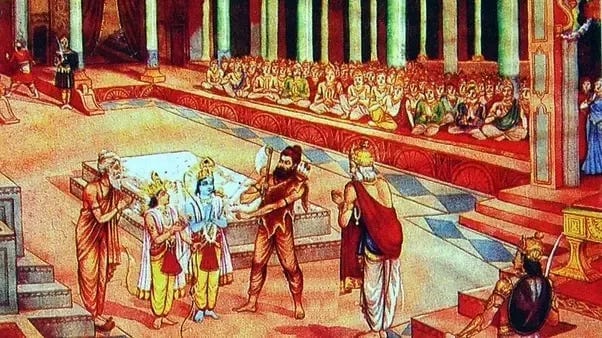
Lakshman continued, "You are still holding your axe. It is I who am sparing you because you are a Brahmin. You’ve never fought a man of the Raghu clan!”
Rama raised his hand and shook his head toward Lakshman. Then, turning to Parashurama, he spoke softly. “My Lord, if this youngster had any idea of your might, he would never be so foolish as to insult you. His pranks are the prattle of a child, so please take pity on him.” Rama paused to bow. “Everyone knows that you are good-tempered and even-minded. Tell me how your anger may be appeased; I will do as you request.”
“You broke Shiva’s bow, and now you speak of appeasing my anger?” Parashurama raised his axe above his head.
Rama bowed his head. No one saw his smile. “The axe is in your hand, great one, and my head is bent before you. Do whatever may pacify your anger, my Lord. I am your servant.”
“There is no quarrel between master and servant,” Rama continued. “Please give up your anger. Have mercy on my brother and me.” Parashurama did not move, still holding the axe high.
“There is no comparison between us. I am the feet; you are the head. I have a little name: Rama, while yours is a long name, the same root, but with ‘Parashu’ affixed. You are my superior in every way. Please, oh great Brahmin, forgive my faults.”
“You are as wicked as your brother! You pretend to mistake me again and again for a mere Brahmin, yet you know who I am!”
Rama raised his head and locked eyes with the mighty Parashurama. “Please, lord, think before you speak. Do you think I insult you by calling you a Brahmin? I do not fear you, Parashurama. I am a warrior of the Raghu clan and know no fear of any man, demon, or god. Any man of my lineage would fight Death himself without hesitation. The glory of a true sage is that one can bow before him and still be fearless. I call you Brahmin out of respect.”
The two stood silently, each one’s gaze taking the measure of the other. Slowly, Parashurama sheathed his axe and took the bow from his shoulder. “Do you think, lad, that you can draw the string of my bow?”
Rama smiled and extended his right hand. The bow left the warrior-sage’s hand and, of its own accord, floated into Rama’s palm.
Parashurama joined his hands together in pranam, and he bowed to the prince. “Lord Vishnu himself told me many years ago that when my life’s work was done, this very bow would pass to the hands of Sri Rama! Glory to You! Forgive me, both brothers, for my words spoken in ignorance.” He bowed deeper. “I leave you now with my blessings and go to the forest to do sadhana (spiritual practices) until this body’s time is spent.”
As Parashurama strode from the arena, drums sounded from the heavens, and flowers rained down upon Rama, Lakshman, Sita, and all remaining.
राम राम राम राम राम राम राम राम राम रामराम राम राम राम राम राम राम राम राम रामम
I’m not putting any of The Journey of Rama behind a paywall - I wouldn’t feel right. Feel free to take a subscription.
I do hope, however, that you will contribute. Writing is how I make my living, and I’d like to spend a lot more time working on this if I can afford to. Additionally, 50% of the income I derive from this work will be donated to Dhyanyoga Centers to support the spiritual and humanitarian endeavors of my Guru, Shri Anandi Ma. If it weren’t for Her, I’d never have been introduced to the Ramayana. The Journey of Rama is a reader-supported publication.
Reply