- The Journey of Rama
- Posts
- Episode Sixteen - Svayamvara
Episode Sixteen - Svayamvara
C.L. Steiner
August 19, 2025
Welcome to the sixteenth episode of The Journey of Rama. If this is your first encounter with The Journey, please read Episode One first.
The Table of Contents is here:
The Journey of Rama is a tale for everyone. If you know anyone who you think might enjoy it, please forward this email to them. Also, please share The Journey of Rama on social media. Thanks!
If you haven’t subscribed to The Journey of Rama, please consider a subscription. You’ll never miss an episode, and they’ll come directly to your inbox!
Every episode is available for free, but if you wish to support the work of creating this publication, click the “Contribute Here” button. 50% of all contributions will be donated to Dhyanyoga Centers.
On with Episode Sixteen!
राम राम राम राम राम राम राम राम राम रामराम राम राम राम राम राम राम राम राम राम
Lakshman’s eyes opened, as always, before dawn. This day, however, he was surprised to find Rama sitting up in his bed, staring out the window at the moon.
“What’s the matter, brother?” Lakshman asked.
“None other than the daughter of King Janak,” said Rama. “I consider myself unperturbable, but the sight of Princess Sita flusters me.”
“I noticed you were even more silent than usual after we visited the garden last night,” Lakshman said, smiling.
“Lakshman, I keep my mind focused always on responsibility and right action. Unlike other young men, I am not moved by passion. But I am drawn to her as people are to the earth itself, and it is as if I know her and always have.”
Lakshman lowered his eyes. He had never heard his brother speak this way. “Perhaps you should seek Vishvamitra’s counsel.”
Rama shook his head. “Not yet. Let us see what we shall see. Feelings come and go, Lakshman, but what is true is always true.”
Sita had also awakened before dawn. She was downhearted, thinking of the mighty, unyielding bow of Shiva and the slender arms of Prince Rama. Sita had been thinking of him, it seemed all night, moving between thought, dream, and (could it be?) memory. The Princess wished that her father had never made the vow establishing the bow sacrifice. She wished...
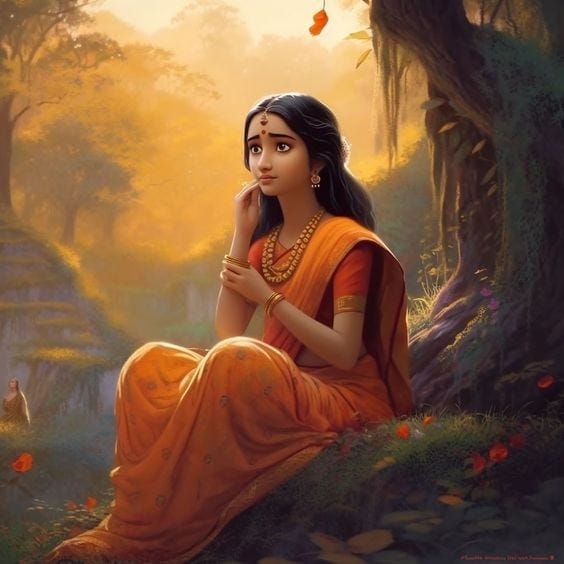
After bathing and performing the daily purification rites, she brought flowers to the palace temple and knelt before the statue of the Divine Mother. “Glory to you, Mother,” she prayed, “You dwell in every heart, so you know my heart’s longing. You bring joy to all who worship you. Please...” Sita could not voice her wish. She bowed and touched the feet of the image. She felt a warmth, a stirring, in the feet. They were marble and yet alive. Sita looked up and saw the Goddess smile. “Sita, your heart’s desire will be accomplished,” the Mother said. “Hear my words as true; Rama will be yours, as he always has been yours.”
The joy and relief in Sita’s heart could only express themselves in her tears. She sewed a garland of flowers as she wept and placed it around the Mother’s neck.
राम राम राम राम राम राम राम राम राम रामराम राम राम राम राम राम राम राम राम राम
Rama sat staring out the window at the full moon, thinking of how Sita’s beauty was even more radiant. No one had ever evoked such a powerful reaction in his young heart, and as the sun appeared above the treetops, he wondered what the day would bring.
Lakshman grinned. “Ah, the day has dawned, and all the valiant and powerful princes that assemble today will tremble before the Prince of the Raghu dynasty when he strings the immovable bow of Shiva!”
Rama’s face darkened. “Don’t make jokes, Lakshman. Perhaps I shouldn’t even try.”
“What? Not try? I would never contradict you, my older brother, nor will I try to compel you, but today is your day. If a blind man had been in that garden yesterday, he would have been able to see that you and Sita are destined to be together. All that stands between you and Janak’s daughter is that bow.”
Rama raised his hands waist high, palms up. “It’s time to bathe, purify, and say our prayers. Let’s not talk about this now.”
Thirty minutes later, the princes bowed at the feet of Vishvamitra. At that moment, King Janak’s Guru, Shatananda, arrived to summon Vishvamitra and the princes to the ceremony.
The two sages led Rama and Lakshman to the arena that had been constructed for the event. As they walked, the citizens of Mithila, men, women, and children, saw the two princes who shone like human diamonds and followed them. The city’s entire population left their duties behind and flocked to the arena.
The king saw the enormous throng gathering and directed his servants and troops to gently and politely escort each citizen to a seat in the arena. It took less than twenty minutes for the entire crowd to be seated.
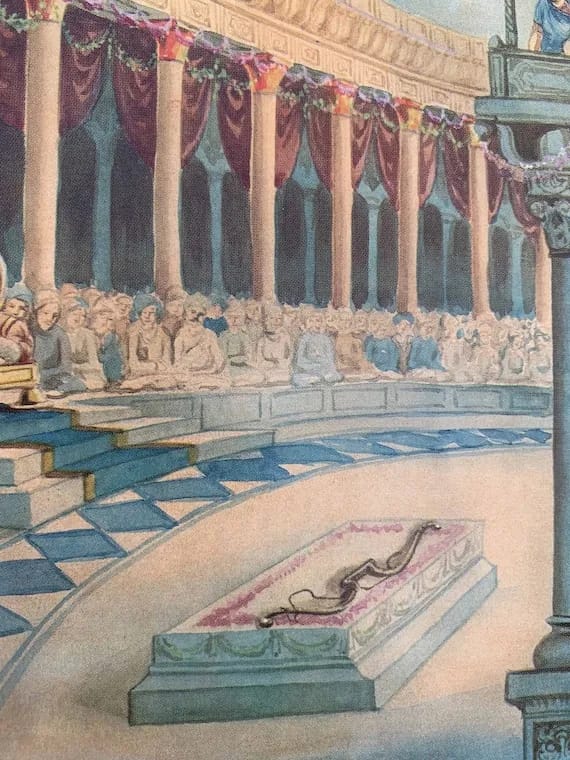
The two princes sat on either side of their Guru, Vishvamitra. They scanned the faces of the dozens of princes who had come to compete for Sita’s hand. Rama could see in each one’s face his true nature. He noted that several of the ‘princes’ were, in fact, demons in disguise; they were afraid to meet Rama’s gaze.
The citizens all viewed Rama and Lakshman with affection, as though they had always known them as friends or relatives. The yogis in attendance could see that there was more to Rama than could be seen with the physical eye, that he glowed with a radiance that was more than human. Some of the competitors looked at Rama and Lakshman and smiled at their tender forms, believing that neither young man would be able to move the bow, let alone lift it.
Suddenly, the sound of trumpets and conch shells blared, announcing the arrival of Princess Sita. All eyes shifted to the king’s section of the arena as Sita and her mother, the queen, entered and took their seats. Sita took the victory garland in her hands, where it would stay until she placed it around the neck of her prospective groom.
The crowd in the arena grew silent. King Janak stood and addressed the crowd. “This is my vow: Whomever in this royal assembly today strings the unbending bow of Lord Shiva shall be wedded to our daughter, and shall triumph over all the three worlds! Let the Svayamvara begin!”
The silence in the arena was almost eerie; the only sounds were chirping birds and the distant squawking of peacocks. All the princes, kings, and other champions stole glances at each other, waiting for one to rise and accept the challenge.
Rama and his brother sat as still as the sage Vishvamitra between them, although Lakshman fairly vibrated with excitement.
Everyone in the arena stole glances at Rama and Lakshman. The suitors who ringed the stadium attempted to size up the two princes and found them wanting – too young, too thin, too unproven. The yogis in attendance recognized Rama immediately. To those holy men, he glowed with divinity, and they knew he was their beloved deity come to Earth. They smiled and said nothing. Sita, the reason for the gathering, could not take her eyes off her beloved. Her mother, the Queen, was also compelled to seek out Rama’s countenance from time to time.
After some time (no one could be certain if it was long or short), a warrior king from a distant land who sat in the front row stood, bowed to King Janak, Queen Sunayana, and Princess Sita, and strode to the rolling cart on which the bow lay. He stared at the bow for a moment, then reached out and seized it with both hands. He tried to pull the bow sideways off the cart, but the bow did not move. He changed the position of his hands and attempted to lift it. The warrior king’s muscles flexed, he strained, and the bow did not budge. After the third try and realizing he had been defeated, the king from a distant land strode back to his seat, stiffly holding on to what was left of his pride.
“How did they get the bow into the arena?” Lakshman asked his Guru.
“Five thousand of the king’s soldiers pulled and pushed the cart from the palace into the arena. It took some time,” answered Vishvamitra. Lakshman nodded.
The second champion, a handsome, cocky young prince, bowed to the royal family with a flourish. He bounded over to the cart and flexed his considerable muscles. King Janak bristled at the muffled laughter in the crowd.
The young prince fared no better than the warrior king. Despite his impressive musculature, he could not move the bow at all. As he walked back to his seat, his step was considerably less jaunty.
Hero after hero, prince after prince, all failed. The atmosphere in the arena had gone from festive to frosty as the svayamvara dragged on. King Janak looked as if he had wagered his crown and lost. Half the suitors who had come in the hope of winning the princess’s hand would not even approach the bow. The demons who had come in disguise had all gone, seeing how hopeless the endeavor would be.
Finally, King Janak rose and raised his hand. When he had everyone’s full attention, he spoke. He did not shout, did not seem to raise his voice, yet all could hear him clearly.
“Hearing of my vow, many a king and many a king’s son have traveled great distances to assemble here, along with other valiant heroes. Even gods and demons have attended in human form. My lovely daughter, great victory, and glorious renown are the prize, but Lord Brahma has not yet created the man who can string Lord Shiva’s bow and attain these rewards.
“Stringing the bow notwithstanding, not one of you, my brothers, could stir it an inch from its place. Be not offended, but retire to the banquet hall, eat your fill, and go home. It is not the will of the Gods that Sita should marry. Perhaps I should not have made such a promise, but all my merit and credibility would be worthless if I were to abandon my vow. There is no worthy hero left in the world.”
Lakshman felt his ears reddening. A vein pulsed in his neck. If he were to give in to his impulse, he would be shouting down King Janak, perhaps even cursing the monarch, but out of respect for his brother, he held back. Still, Lakshman bowed his head toward Rama and softly said, “Brother, no one would ever dare speak such words with one of our family in the room, and Janak knows we are here. Just say the word, brother, and by your grace, I will smash Mount Meru as if it were a turnip. What is a bow to you? Give me your command, and I will string the bow, shoot an arrow with it, and carry it back to Ayodhya!”
Rama rested his hand on Lakshman’s shoulder, smiled at him, and shook his head. “Sit, please, Lakshman.”
Vishvamitra leaned toward Rama with a grin and said, “Go now, Rama. String the bow of Shiva and relieve King Janak of his anguish.”
Rama bowed to his Guru’s feet. He stood again, neither smiling nor frowning, a look of complete peace and equanimity on his face. He strode gracefully toward the cart upon which rested the bow.
The sages and yogis murmured prayers to Lord Ganesh, remover of obstacles. Sita and her mother silently prayed to that same elephant-headed god. Sita swore in her heart that, no matter what happened here today, she would love Rama for eternity.
Rama stood over the bow, considering it as the king of eagles would consider a little serpent. He touched the bow with his right hand, grasped it, and lifted it easily. He pulled the string from the top to stretch it to the bottom when the bow snapped in half.
The thunderous crashing sound of the breaking bow was deafening to those in the arena. All could feel the earth shake. The sound could be heard and the tremor felt for hundreds of miles. Rama dropped the two halves of Lord Shiva’s bow back onto the cart and looked up at Sita as she gazed upon his face.
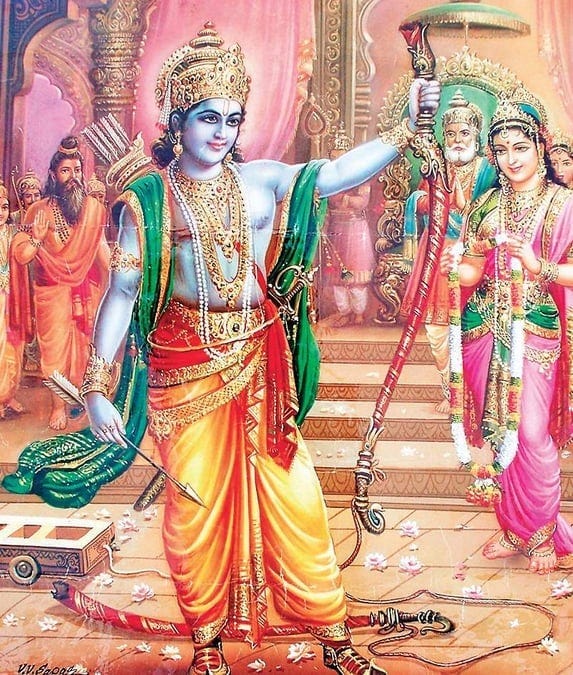
The relief of the King was palpable, spreading throughout the crowd. Shouts of “Jai Siya Ram” (Glory to Sita and Rama) filled the air as news spread swiftly through the city.
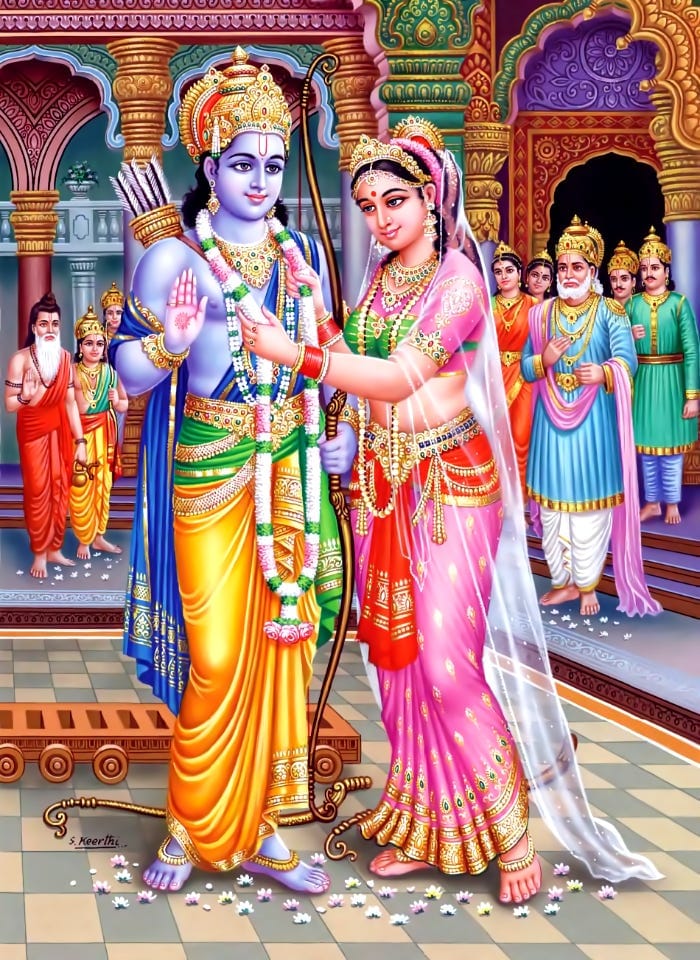
Satananda, the preceptor to the royal family, led Sita to the arena floor. In her hands was a massive garland of flowers from the palace garden, the very flowers Sita and her sisters had picked the previous evening. She approached Rama, who bowed his head slightly as she placed the garland around his neck with steady hands.
At that moment, flower petals rained down from the skies as heavenly trumpets and conch shells blew. Rama and Sita’s betrothal was both an earthly and celestial celebration.
राम राम राम राम राम राम राम राम राम रामराम राम राम राम राम राम राम राम राम रामम
I’m not putting any of The Journey of Rama behind a paywall - I wouldn’t feel right. Feel free to take a subscription.
I do hope, however, that you will contribute. Writing is how I make my living, and I’d like to spend a lot more time working on this if I can afford to. Additionally, 50% of the income I derive from this work will be donated to Dhyanyoga Centers to support the spiritual and humanitarian endeavors of my Guru, Shri Anandi Ma. If it weren’t for Her, I’d never have been introduced to the Ramayana. The Journey of Rama is a reader-supported publication.
Reply